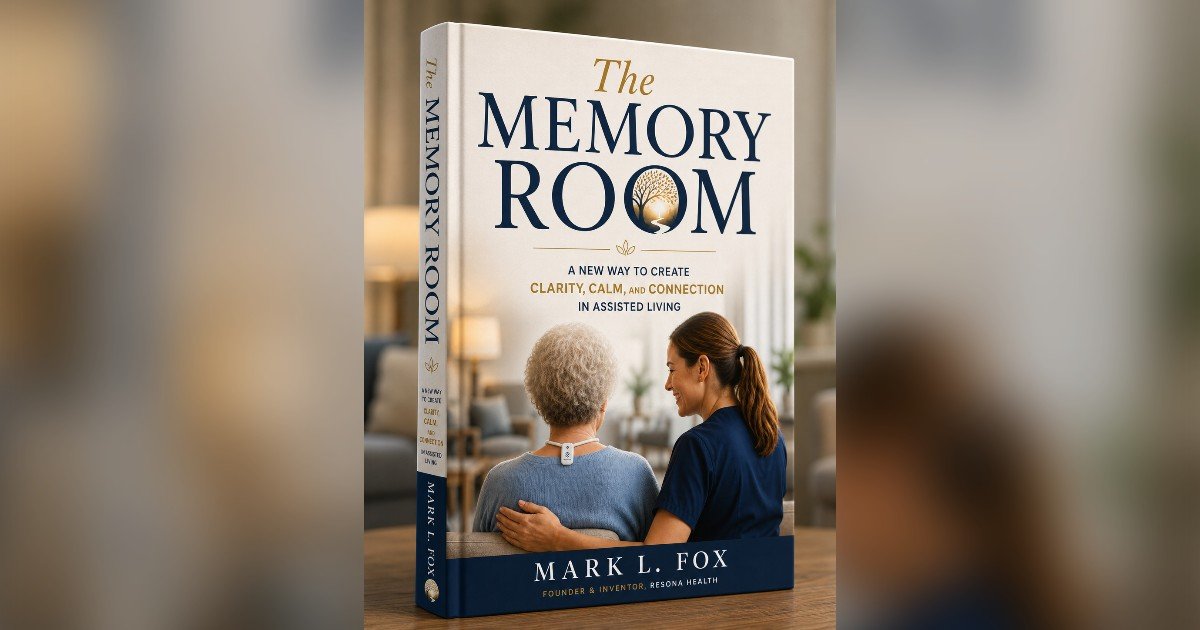
A new book is challenging one of memory care's most deeply held assumptions: that little can be done beyond managing symptoms. At a time when more than 55 million people worldwide are living with dementia, The Memory Room: A New Way to Create Clarity, Calm, and Connection in Assisted Living by Mark L. Fox offers a vision for supporting cognitive function through non-invasive interventions.
Fox, founder of Resona Health and a former aerospace engineer, draws on research from MIT's Picower Institute for Learning and Memory and clinical findings from a completed Phase 1 study. The book examines 40 Hz gamma stimulation, an area of neuroscience that gained international attention following MIT studies demonstrating potential influences on biological processes associated with brain health, including microglial activation and neural network coordination.
At the center of the discussion is BlueVibe, a wearable device developed by Resona Health that combines pulsed electromagnetic field (PEMF) technology and pulsed blue light stimulation at 40 Hz. According to a six-week Phase 1 study involving 41 participants, all 41 participants demonstrated improvement in measured cognitive function scores, with no regression or adverse effects reported. Statistical analysis produced a p-value of less than 0.000001.
"Anyone who has spent time in memory care has seen it," said Fox. "A resident who suddenly remembers a family member's name... The question is no longer whether these moments happen. The question is whether we can help create the conditions that allow them to happen more often."
Fox emphasizes that neither BlueVibe nor any existing technology should be viewed as a cure for Alzheimer's disease or dementia. "This is not a book about curing dementia," he explained. "It's a book about supporting the brain's remaining capacity."
The book is written for assisted living operators, memory care directors, nursing leaders, healthcare administrators, clinicians, caregivers, and families. Healthcare leaders may find particular relevance in discussions of non-drug interventions, implementation challenges, caregiver burnout, and the growing demand for innovative memory care solutions.
The Memory Room is available on Amazon. More information about Resona Health can be found at resona.health.