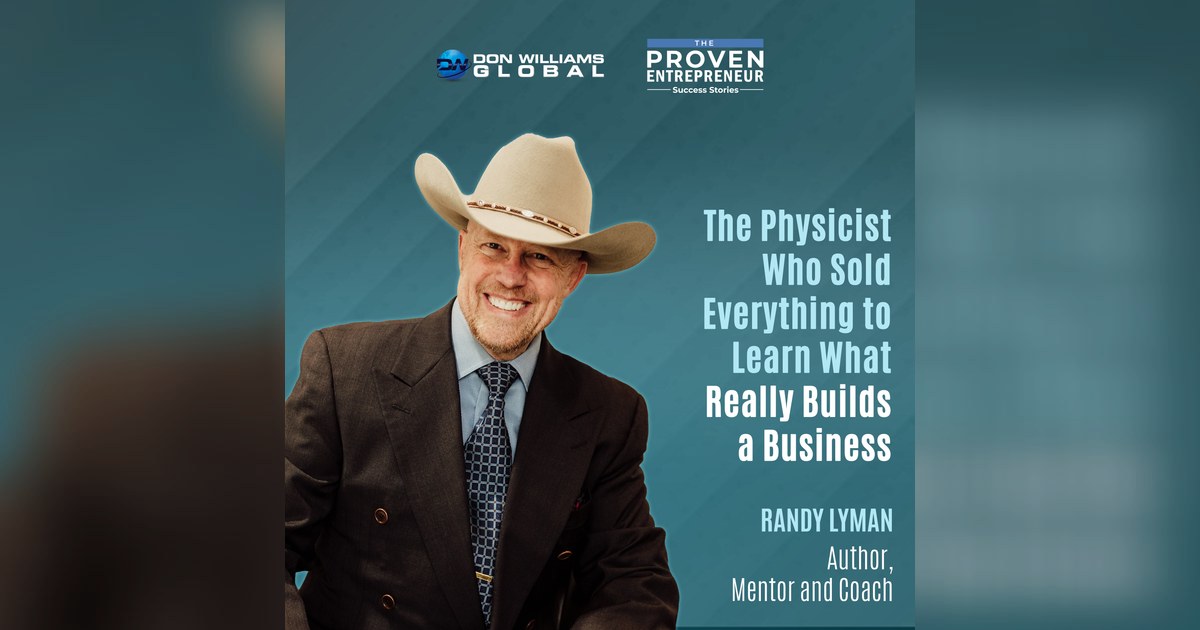
In a world obsessed with growth hacks and strategic frameworks, physicist and serial entrepreneur Randy Lyman offers a counterintuitive thesis: the real engine of durable business success is emotional mastery. Lyman, who holds multiple patents and has built and exited several eight-figure companies, made this case in Episode 170 of The Proven Entrepreneur podcast, hosted by Don Williams. The episode, titled 'The Physicist Who Sold Everything to Learn What Really Builds a Business,' was published on August 31, 2026, and challenges conventional wisdom about what drives long-term entrepreneurial achievement.
Lyman, who earned a spot on the Inc. 500 (not the 5,000), argues that high-IQ founders often stall not because of flawed strategies but because of unresolved emotional patterns. 'They proceeded to tell me that I was the problem for the business and that I could do better and I needed to look at myself in a nutshell,' Lyman recalls of a pivotal 1999 moment that reset his career. 'And they were right.' This candid admission underscores his belief that self-awareness and emotional regulation are foundational to leadership effectiveness.
The conversation between Williams and Lyman moves quickly from résumé to reckoning, unpacking the hidden emotional costs of entrepreneurial ambition. They discuss the 1989 Ford truck that exposed the emptiness of material milestones, the tendency of young men to shut off emotions to survive and later pay for it as leaders, and the surprising intersection of quantum physics and the law of attraction. Lyman, a 64-year-old who says he is still comfortable crying his tears, does not soften the physics or the feelings.
For those skeptical of such claims, Lyman offers a grounded translation: he sorts all of reality into three categories—thought and information, the physical body and world, and emotions—and argues that unresolved emotional energy creates a harmonic resonance that the universe keeps mirroring back. He applies this to the boardroom, describing how tense founders trigger board members who behave 'like wolves,' while calm, emotionally clear leaders defuse the room. He also connects the physics definition of power—the ability to accomplish work—to team performance, insisting that profits, expansion, and industry change follow leaders who serve their people first.
Don Williams, the host, traces his own turn to a talk he heard in Bangkok, Thailand, roughly a decade ago, delivered by a researcher now completing a doctoral program at Oxford on the intersection of neuroscience and spirituality. That talk convinced Williams that humans perform at their best in gratitude and at their worst in shame and fear. He now describes gratitude as a business 'cheat code' and has made it his mission to move a million people into a daily gratitude practice.
The episode offers a working framework drawn from Lyman's book The Third Element, along with concrete stories from the factory floor and the boardroom. Lyman's message is clear: strategy and grit are necessary but insufficient. Emotional mastery is the missing ingredient that allows leaders to harness their full potential and create lasting impact. For founders seeking to scale not just their companies but themselves, this episode provides a compelling case for looking inward before looking outward.