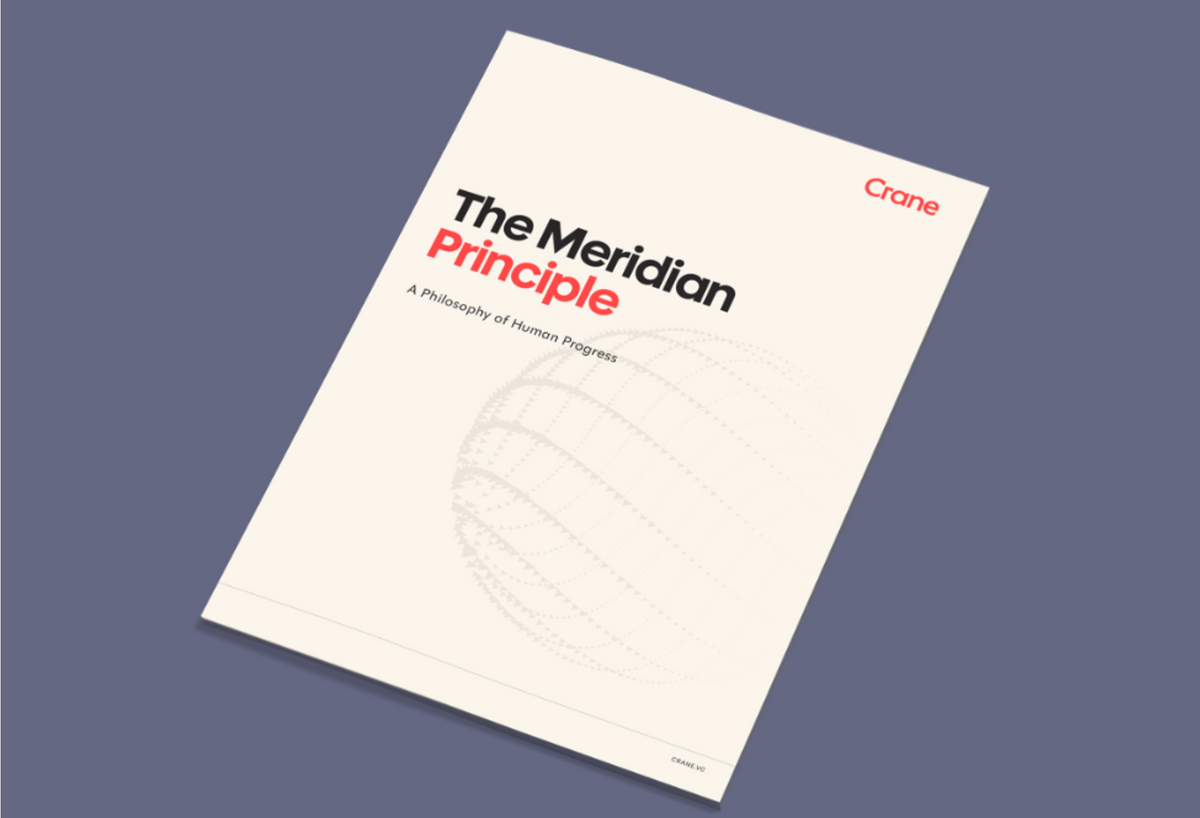
Crane Venture Partners today published The Meridian Principle, a philosophy of human progress that articulates the beliefs behind where the firm looks, who it backs and why it believes the greatest discoveries remain ahead of us. The announcement marks a significant moment for the venture capital industry, as it signals a deliberate shift toward a more interdisciplinary approach to investing in foundational technologies.
The Meridian Principle asserts that human progress accelerates when extraordinary people connect ideas across disciplines. According to Crane, AI is dissolving traditional boundaries between fields, sparking a new wave of discovery. This perspective is particularly relevant as the global economy increasingly relies on AI to solve complex problems, from healthcare to climate change. By framing AI as a catalyst for cross-disciplinary innovation, Crane positions itself at the forefront of a philosophical movement that could influence how other investors evaluate startups.
The firm prioritizes backing synthesist founders—deep experts who refuse disciplinary constraints. This approach challenges the conventional venture capital practice of focusing on founders with proven track records in specific verticals. Instead, Crane deliberately looks beyond familiar networks and established innovation hubs to find these outliers. This strategy could uncover hidden gems in underserved regions or overlooked fields, potentially reshaping the geography of innovation.
For founders, the Meridian Principle offers a clear signal: Crane is committed to supporting those who think differently and operate at the intersection of disciplines. This could be a magnet for visionary entrepreneurs who feel constrained by traditional funding criteria. Moreover, Crane defines its investor role as coupling capital with connection and conviction. The firm links founders with scientists, entrepreneurs with researchers, and academia with industry, providing more than just financial backing. This hands-on approach, which includes helping founders refine go-to-market strategies and scale globally, could be a key differentiator in a competitive funding environment.
The announcement also reflects a broader trend in venture capital: the growing recognition that breakthrough innovations often emerge from interdisciplinary collaboration. By formalizing this belief in a named principle, Crane is not only articulating its own investment thesis but also contributing to a larger conversation about the future of innovation. As other firms observe Crane's success with this approach, they may adopt similar philosophies, potentially leading to a more interconnected and collaborative startup ecosystem.
However, the Meridian Principle is not without its challenges. Identifying synthesist founders requires a nuanced understanding of multiple fields, which is difficult to scale. Additionally, backing such founders often involves higher risk and longer timelines, as their ventures may not fit neatly into existing market categories. Crane's commitment to remaining through the uncertainty required to build enduring companies suggests that it is prepared for these challenges, but it remains to be seen whether other investors will follow suit.
In a world where AI is rapidly transforming industries, the Meridian Principle offers a timely and optimistic vision: that the greatest discoveries are yet to come, and that by connecting the dots across disciplines, humanity can unlock unprecedented progress. For Crane Venture Partners, this philosophy is not just a statement of intent but a practical guide for identifying and nurturing the next generation of world-changing companies.