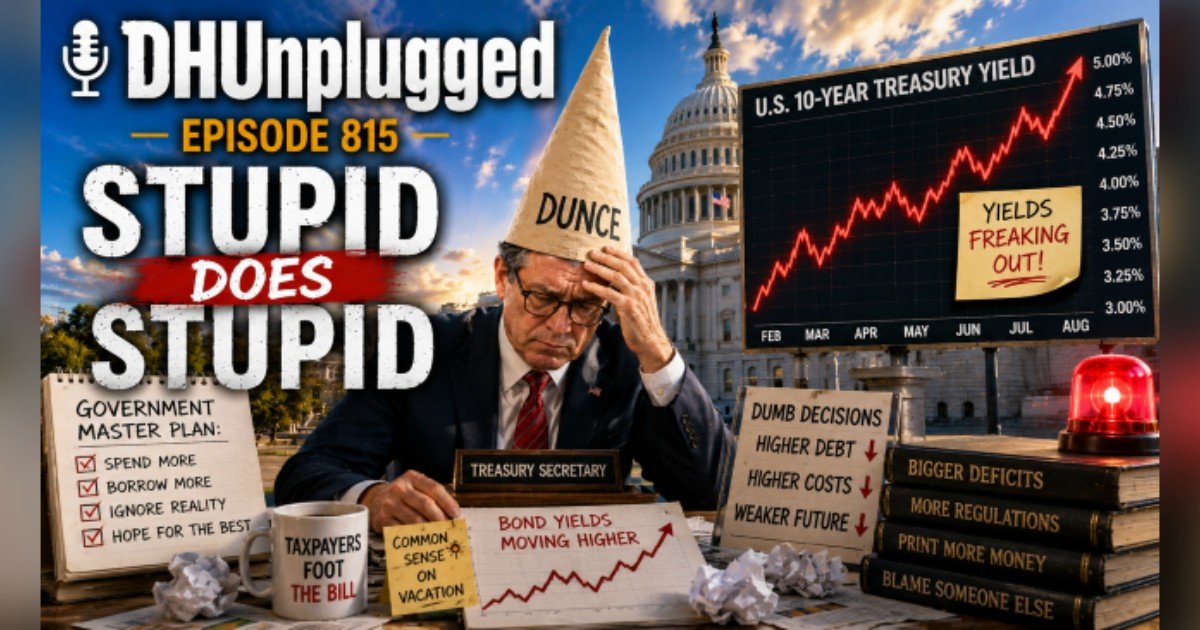
The latest episode of DH Unplugged, titled 'Stupid Does Stupid', delivers a sharp-tongued audit of what hosts Andrew Horowitz and JC Dvorak call the five dumbest moves currently shaking financial markets. Published August 25, 2026, the episode arrives days before NVIDIA's closely watched earnings report and the Jackson Hole economic symposium, framing a week in which Treasury maneuvers, tariff reversals, and a weakening U.S. dollar are colliding with sky-high AI expectations.
At the top of the list is Treasury Secretary Scott Bessent's expanded long-bond buybacks, which the hosts dub 'Bessent's Big Bond Blunder'. Horowitz and Dvorak argue that the move, which hints at a potential $4 billion monthly pace, is being misinterpreted by markets as a form of quantitative easing. However, Horowitz insists, 'There is no quantitative easing going on. The dollar is down, but not that much. The fact is that everybody just wants to buy it. This is an excuse.' Dvorak counters that if retail buyers believe the story, image control is working, even though rates snapped back after Bessent's Friday follow-up. They also flag unusual inflows into TLT on August 18, the day before the announcement, calling it 'information leakage,' not luck.
The episode also tackles Trump's tariff cut on imported beef, questioning who actually pays tariffs. The hosts point out that such moves often have unintended consequences, and the debate over tariff incidence is more complex than simple political rhetoric suggests. New Iran sanctions, targeting roughly 60 individuals, companies, and vessels under 'Operation Economic Outcast', add another layer of geopolitical risk, potentially affecting oil markets and global supply chains.
Bitcoin's rip past $80,000 and gold's move on a softer dollar are examined, but the hosts caution against taking the debasement trade at face value. They argue that while the dollar has weakened, it's not as dramatic as some claim, and the narrative may be overblown. Walmart's consumer warning, with U.S. comparable sales up just 2.6% against roughly 3% inflation, signals that consumers are feeling the pinch. Dvorak, who has consulted with Walmart's data science team, argues that the retailer's predictive models make its caution credible, not corporate spin. He also notes Costco's earlier warning about shoppers swapping chicken for tuna as a recession tell.
On NVIDIA, the hosts spotlight Kingslide Works, the Taiwanese maker of roughly 70% of data center rack slides, which is up about 400% in a year, as an early indicator ahead of the Ultra Rubin chip cycle. They also dig into Venezuelan oil refining bottlenecks, strategic petroleum reserves near 1983 levels, salt-cavern integrity risks in Texas and Louisiana, and China's 90% share of Iranian oil imports, all of which could have significant market implications.
The episode underscores the interconnectedness of these issues, from Treasury policy to consumer behavior to global supply chains. As Horowitz and Dvorak suggest, investors should not blindly follow the debasement narrative but instead scrutinize the underlying data. With NVIDIA earnings and Jackson Hole on the horizon, the coming weeks will likely test the resilience of current market optimism.